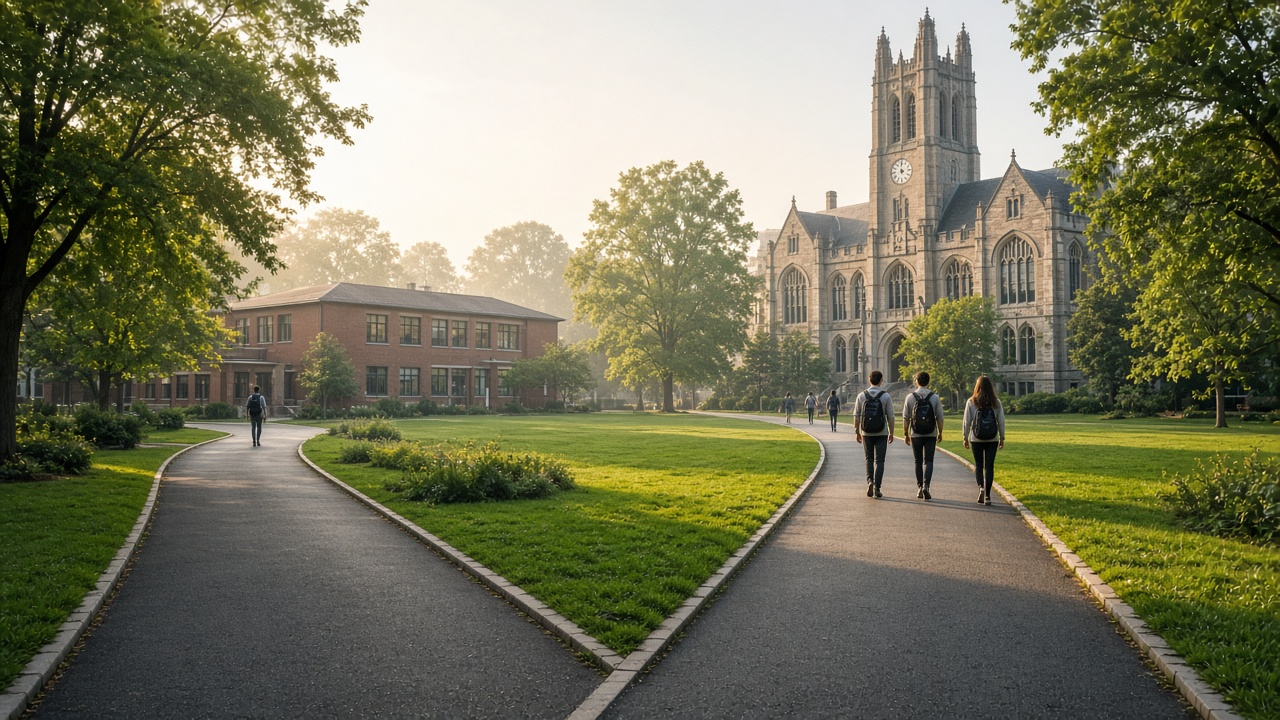
For many students, the first big education decision is not what to study but where. Community colleges and four-year universities offer different strengths, and the right choice depends on your goals, budget, academic preparation and life circumstances. Both can lead to a bachelor’s degree, but they travel different roads.
This guide compares the two paths across cost, class experience, support, transfer and career outcomes, then offers a framework for deciding.
The Basics
Community colleges are typically two-year institutions that award associate degrees, certificates and vocational credentials. Many have open admission, meaning most applicants who meet minimal requirements are accepted.
Four-year universities award bachelor’s degrees and often master’s and doctoral degrees. Admissions can range from open to highly selective.
Cost Comparison
Cost is the biggest difference. Community college tuition per credit is often a fraction of that at public universities and far lower than at private universities. Over two years, the savings can reach tens of thousands of dollars, especially when you also avoid on-campus housing by living at home.
Consider these cost elements:
- Tuition and fees: Community college is typically the lowest.
- Housing and meals: Many community college students live at home, which reduces costs.
- Books and supplies: Similar across schools, with options to rent or buy used.
- Financial aid: Community college students can qualify for federal and state aid. Some states offer free or reduced tuition programs for eligible students.
- Opportunity cost: Working while studying can offset expenses, and community colleges often offer flexible schedules.
Use net price calculators for each school you are considering, because generous aid can narrow the gap between sticker prices.
Academic Experience
Class size and attention
Community college classes are often smaller, particularly in introductory courses, which can mean more individual attention from instructors. Large universities may have lecture halls with hundreds of students in first-year courses, although many provide discussion sections and tutoring.
Faculty
Community college instructors are typically focused on teaching rather than research. Universities may employ renowned researchers, giving advanced students opportunities for research and mentoring, though undergraduates sometimes find that teaching assistants lead many classes.
Course variety and depth
Universities usually offer a wider range of majors, advanced courses and specialized programs. Community colleges excel at foundational courses, career and technical programs, and some offer select bachelor’s degrees.
Flexibility
Community colleges often provide evening, weekend and online classes designed for working students and parents, along with part-time options.
Support and Campus Life
- Community colleges often have strong advising for transfer, tutoring and support for first-generation and returning students. Campus life can be quieter, with fewer residential programs.
- Universities typically provide a broader campus experience: residence halls, clubs, athletics, research opportunities, networking and large alumni networks.
Both offer career services and counseling, but quality varies, so ask about resources when you visit.
Transfer Pathways
Many students start at a community college and transfer to a four-year university to complete a bachelor’s degree. This can be an efficient and economical route when planned carefully.
Make transfer work
- Choose your intended major and target schools early.
- Meet with a transfer advisor in your first semester.
- Follow the transfer curriculum specified by articulation agreements or guaranteed admission programs, which many states provide between community colleges and public universities.
- Check that credits will count toward your major and not only as electives.
- Maintain the GPA needed for admission to your target program, especially competitive majors.
- Apply on time and check deadlines for scholarships for transfer students.
- Get written confirmation of credit evaluations when possible.
Research indicates that transfer outcomes vary widely by state and institution, and not every student who starts at a community college completes a bachelor’s degree. Planning and support make a big difference.
Career and Earnings Outcomes
Bachelor’s degrees on average lead to higher lifetime earnings than associate degrees, though individual results depend heavily on field, location and experience. At the same time, certain associate degrees and certificates in high-demand fields, such as nursing, dental hygiene, information technology and skilled trades, can lead directly to well-paying jobs with less time and debt.
Employers often care more about your skills, experience and degree than where you took your first two years. The diploma from a four-year university generally lists only that institution if you transfer and graduate there.
When Community College Makes Sense
- You want to reduce costs and borrowing
- You are unsure about your major and want to explore
- You need to improve your academic record before applying to a university
- You work or have family responsibilities and need flexibility
- You want job-ready skills in a technical field
- You prefer smaller classes at the start
When a Four-Year University May Be Better
- You have a clear major that requires a specific program or sequence
- You want an immersive campus experience, living on campus and joining activities
- You plan to enter a highly competitive field where university networks and research opportunities matter
- You received generous aid or scholarships that make the cost comparable
- You are ready academically and want to avoid transfer complications
A Decision Framework
- Clarify your goals: Bachelor’s degree, certificate, career change or exploration?
- Estimate total cost for each path using net price calculators.
- Evaluate academic readiness and support needs.
- Research program outcomes: Graduation rates, transfer rates, job placement and earnings.
- Check transfer agreements if you choose community college first.
- Visit campuses and talk to students and advisors.
- Consider the human factors: Distance, family obligations, community and well-being.
- Keep options open. Applying to both types of institutions lets you compare offers.
Tips for Success in Either Path
- Meet with advisors regularly and plan your courses semester by semester
- Use tutoring, writing centers and office hours
- Get involved in at least one activity or community
- Seek internships and work experience
- Build relationships with professors, who can write recommendation letters
- Track deadlines for financial aid, scholarships and transfers
Final Thoughts
There is no universally better option. Community college can be a smart, affordable launchpad, and a four-year university can offer depth and opportunities that suit certain goals. What matters is aligning the choice with your career plans, finances and learning needs, and planning each step carefully.
This article is for general information and does not constitute personal academic or financial advice. Verify details with the schools and relevant state agencies.
Frequently Asked Questions
Do employers look down on community college? Generally no. Employers focus on your degree, skills and experience. If you transfer and graduate from a four-year institution, your diploma comes from that university.
Will all my credits transfer? Not always. Credits are most likely to transfer within the same state between public institutions with articulation agreements. Ask for a written credit evaluation and confirm that courses count toward your intended major.
Can I still get a full college experience starting at community college? Many community colleges have clubs, student government, honors programs and athletics. Some students also join activities at the university they plan to transfer to once they enroll.
Is it harder to get into a selective university as a transfer student? It varies. Some selective schools admit transfer students at lower rates than freshmen, while others have strong transfer pipelines. Research the specific school’s transfer statistics and requirements early.
What if I am not sure what to study? Community college is a low-cost place to explore. Take introductory courses in several fields, meet with advisors and use career assessments before committing to a major.